
Architecture
Transmute Core owns the loop and rendering surface. Your game supplies three callbacks and obtains services through Manager. The core has no external runtime dependencies.
One authoring model

Diagram source
flowchart TD
    Game[Your TransmuteCore subclass] --> Manager[Manager]
    Manager --> Assets[AssetManager]
    Manager --> States[StateManager]
    Manager --> Objects[ObjectManager]
    Manager --> Input[Input handler]
    Game --> Context[Context pixel renderer]
    Game --> World[World and Body2D]
Call manager.bootstrapDefaults() in init() to install the standard managers. GameContext is the internal dependency container; game code should use Manager.
Lifecycle
init() runs once. update(Manager, double) advances game logic using the engine's fixed timestep. render(Manager, IRenderer) draws the frame. Cast IRenderer to Context when you need pixel operations.
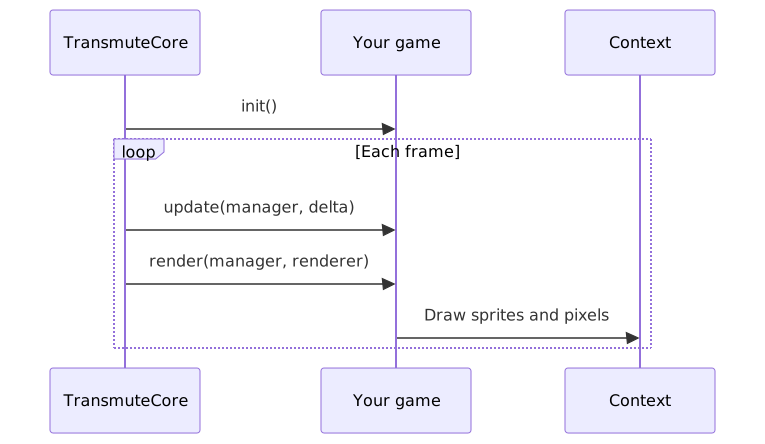
Diagram source
sequenceDiagram
    participant Engine as TransmuteCore
    participant Game as Your game
    participant Renderer as Context
    Engine->>Game: init()
    loop Each frame
        Engine->>Game: update(manager, delta)
        Engine->>Game: render(manager, renderer)
        Game->>Renderer: Draw sprites and pixels
    end
Pick the built-in module
| Need | Use |
|---|---|
| Images, fonts, sound | AssetPack and GameSpec |
| Menus and gameplay screens | StateManager; leave a state with pop() |
| Tile worlds and triggers | World and GameSpec.createWorld() |
| Gravity and collision | Body2D and Collision |
| Repeatable tests | GameHarness, SimulatedInput, FrameAssert, AudioProbe |
Avoid building a parallel entity or map system. See the API reference and authoring guide for concrete usage.